
Every peak-summer week on Emerald Isle gets booked out to the same people, year after year, often before the previous season even ends. Meanwhile, six to eight weeks of genuinely good beach weather sit half-empty every fall, at a fraction of the price, because most travelers still think “beach vacation” means July.
This is the actual math on off-season rentals here: what you save, what you give up, and which weeks are worth targeting if your schedule has any flexibility at all.
Why Off-Season Even Works on Emerald Isle
Not every beach town has a real off-season option. Some places get cold and grey the moment Labor Day passes and the whole town shuts down with it. Emerald Isle doesn’t work that way, for one specific reason: the Gulf Stream runs close to the Crystal Coast, and the Atlantic holds its summer heat for months after the calendar says otherwise.
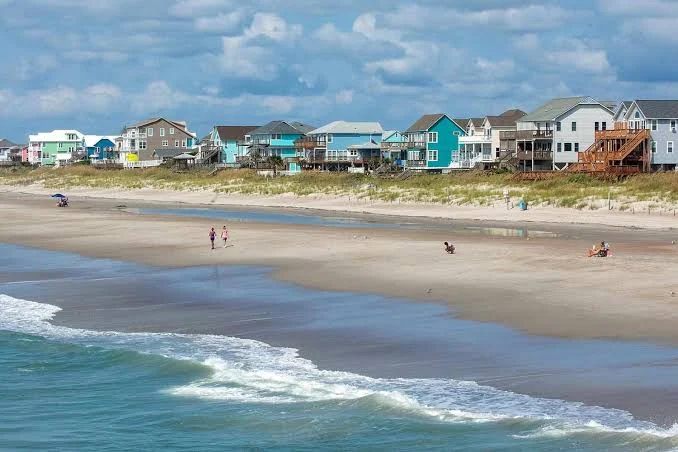
That means the “off-season” here isn’t really off, it’s a second, quieter summer that most people miss entirely. We cover the full month-by-month breakdown in our guide to the best time to visit Emerald Isle; this post is specifically about the value case for going outside peak weeks.
What Fall and Spring Actually Cost
The rate difference between peak summer and shoulder season at Dune Castle is substantial, not a small discount, but roughly half:
- Peak summer (April–August): weekly rates run $1,756 to $4,290 depending on the exact week
- Fall (September–December): weekly rates run $2,220 to $2,960
- Winter (January–April): weekly rates run $2,358 to $2,620
Read that fall number again against peak summer, a fall week at the same oceanfront property, sleeping the same 10 or 20 guests, can run less than half of a top summer week. For a family that would otherwise stretch to afford a single July week, that gap can mean the difference between one week and two, or between one unit and both sides combined for the whole extended family.
What You’re Actually Trading Off
Being honest about the trade-off matters more than selling it, so here’s exactly what shifts:
- You lose the school calendar. Fall and spring weeks work best for retirees, remote workers, homeschooling families, and couples without kids in school. If your dates are locked to a school break, this section isn’t really for you,though early June and late August still land in shoulder-adjacent territory with softer crowds than peak July.
- You gain the ocean, mostly intact. Water temperatures often stay in the upper 70s through late September and remain swimmable into October, this isn’t a “look at the water from the deck” off-season, it’s a genuinely swimmable one for most of the window.
- You gain the best fishing of the year. Fall mullet and spot runs bring fish within casting range of the beach, timing details are in our surf fishing guide.
- You gain real elbow room. The crowd difference between a July Saturday and an October Tuesday isn’t subtle, see what summer crowds actually look like for the peak-season baseline you’re comparing against.
- You take on slightly more weather risk. September carries the highest hurricane-season activity on the NC coast. Most weeks pass without any disruption, but book with a clear understanding of the cancellation policy and keep half an eye on the forecast the week before travel.
Fall vs Spring: Which Shoulder Season Fits You
They’re not identical, and picking the right one matters:
- Fall (mid-September through October) has the warmer water of the two, the better fishing, and the most dramatic contrast with summer crowds. This is the stronger pick if swimming matters to your trip.
- Spring (March through May) has the lower rates of the two and the best shelling after winter storms turn the sand over, but the ocean typically isn’t reliably swimmable until late May. This is the stronger pick if a beach-adjacent trip, walking, fishing, biking, day trips, matters more than getting in the water.
- Both beat peak summer on rate, crowd level, and parking availability at every attraction from the NC Aquarium to Beaufort’s waterfront.
Why Off-Season Works Especially Well for Larger Groups
Shoulder season compounds in value the bigger your group gets. A family reunion or multi-generation trip that would cost a fortune to book both sides of an oceanfront duplex in peak July becomes genuinely affordable in October, same 20-person capacity, same interior connecting door between units, a fraction of the price. We go through the full group-format math in why an adjoining duplex works better than two separate houses, and off-season is where that math tilts most in your favor.
Restaurant tables are easier to get for a group of twelve. Ferry bookings to Cape Lookout don’t need to be locked in weeks ahead. Parking at the aquarium or Fort Macon is never a question. Everything that’s mildly stressful about coordinating a large group in July simply isn’t a factor in October.
Booking an Off-Season Week
The mechanics don’t change,what changes is how early you need to move. Counterintuitively, the best off-season weeks don’t sit wide open right up until the date. A meaningful share of our shoulder-season bookings come from returning guests who know the value and lock in their fall week before it’s ever really “available” to a first-time searcher.
Minimum stay requirements also loosen outside peak season, so a shorter trip than the standard Saturday-to-Saturday week may be possible, check specifics on our FAQ page or reach out directly before booking.
Booking direct matters here too, arguably more than in summer: on a $2,400 fall week, a typical 12–15% OTA service fee is another $300–$360 that a direct booking simply doesn’t charge. See the full case for booking direct if you want the complete breakdown.
Is Off-Season Worth It?
For anyone not bound to the school calendar, yes clearly. You get most of summer’s water, all of the property, none of the crowd, and roughly half the rate. The only real cost is flexibility on when you can travel, and a slightly higher (but very manageable) weather-watch during September specifically.
Check open fall and spring dates and book direct, no platform fees, and the shoulder-season rate is applied automatically at checkout.